

In partnership with

Today, we want to talk about an ETF that sounds like a contradiction: an actively managed ETF from a 90-year-old asset manager that is still, by ETF standards, the new kid on the block.
Capital Group is not a name most ETF investors grew up with. The firm built its reputation running legendary American Funds mutual funds. It manages roughly $2.7 trillion in client assets and has been doing bottom-up stock research since 1931. For decades, they operated behind the high walls of traditional mutual funds, charging standard fees and ignoring the passive indexing revolution. But the market shifted, and investors demanded the tax efficiency, liquidity, and transparency of exchange-traded funds. Capital Group answered. They brought their deep research bench and active management pedigree into the ETF space, and they are now a powerful player in this arena.
Today, we are looking at one of their most compelling offerings: the Capital Group Conservative Equity ETF (CGCV).
This is not a fast-money tech fund. It is not trying to catch the next artificial intelligence breakout. Instead, it is a deliberately defensive vehicle. We are going to strip this fund down to the studs, examine how it actually works, and figure out exactly where it belongs in your portfolio.
Your Next Side Hustle is Already on This List

Ready to stop scrolling job boards and start building something of your own?
The Hustle's free "Side Hustle Ideas Database" uncovers 100 unconventional, actually-actionable ways to earn on the side.
Inside you'll find:
A curated list of 100 real side hustle ideas spanning e-commerce, services, content, and weird corners of the internet most people never think to look
Opportunities at every level, whether you have 5 hours a week or 50, zero capital or a small runway
Offbeat, under-the-radar ideas you won't find in generic "how to make money" listicles
Subscribe for free today and get instant access. Your next income stream is one click away.
What is CGCV?
What exactly does this fund do? The mandate is straightforward: CGCV pursues conservative growth and income investing.
The managers achieve this by investing primarily in well-established companies with strong balance sheets and a history of consistently paying dividends. Their ultimate goal is twofold. They want to provide capital preservation when the market turns ugly, and they want to generate a steady stream of income along the way. Conservatively managed to reduce volatility and risk, this fund has the potential to provide downside resilience during severe market declines.
Let us break down what those mechanics actually look like in practice.
Most passive ETFs operate top-down. You buy a market-cap-weighted index and get whatever the market hands you. If highly leveraged companies suddenly become 20% of the index, you own them. Capital Group takes a different path.
The firm uses a strict bottom-up investment strategy. Analysts ignore macroeconomic noise—like trying to guess the Federal Reserve’s next rate move—and focus entirely on corporate fundamentals.
Here is what that focus looks like in practice:
💪🏼Balance sheet strength: Managers hunt for low debt-to-equity ratios and high interest coverage ratios. The test is simple: can a company service its debt even if revenue drops by a quarter? If not, it is out.
🤑Dividend sustainability: The team digs into cash flow statements to verify that dividends are real. A high yield is often a trap—a stock yielding 9% usually signals the market expects a cut. CGCV avoids these yield traps. The managers prefer a company paying a 2% yield that grows its dividend by 8% annually over one paying a stagnant 6% yield financed by borrowing.
🏋🏼Barbell portfolio structure: CGCV’s holdings form two complementary blocks:
📈Growth engines: Blue-chip technology and healthcare names—think Microsoft, Broadcom, Eli Lilly—to keep up during bull markets.
🛡️Defensive anchors: Low-beta consumer staples and financials—Philip Morris, Starbucks, JPMorgan Chase—to provide ballast when markets fall.
This blend is not an accident. The growth names ensure the fund does not fall too far behind in strong markets, while the defensive anchors deliver the promised capital preservation during a rout.

Under the Hood: The Mechanics of CGCV
Investment Strategy📊
Knowing what a fund does is only half the battle. You need to know how to use it. If you hold a portfolio of ETFs, haphazardly throwing CGCV into the mix will disrupt your asset allocation. You have to place it with intent.
Consider three different investor profiles and how this fund integrates into their strategies.
💡The Aggressive Accumulator: If you are in your thirties, your portfolio might be heavily skewed toward aggressive growth. You likely hold broad market index funds heavily concentrated in tech, or perhaps specific growth vehicles tracking the Nasdaq 100. Holding 100% growth equity is mathematically optimal over a fifty-year timeline, but it is psychologically brutal. When the market drops 30%, many investors panic and sell at the bottom. CGCV acts as a behavioural buffer here. Allocating 15% to 20% of your portfolio to a conservative equity fund dampens the overall volatility. It gives you a stable core that bleeds less during market crashes, helping you stay the course with your aggressive growth holdings.
🪐The Core-Satellite Builder: Many ETF investors use a core-satellite approach. They put 70% of their money into a broad, passive index, and use the remaining 30% to make tactical bets. CGCV flips this script effectively for cautious investors. You can use CGCV as the actively managed core of your portfolio. Because the fund specifically targets downside resilience, it provides a very solid foundation. You can then use your satellite positions to take concentrated risks—perhaps buying a small-cap value ETF or an emerging markets fund—knowing your core is heavily fortified.
💵The Income Transitioner: Investors approaching retirement face a specific dilemma. They need to shift from pure capital appreciation to income generation, but they cannot abandon equities entirely due to inflation risk. CGCV fits perfectly into this transition window. It offers a moderate dividend yield—usually hovering between 1.4% and 1.6%—but more importantly, it holds companies that consistently grow those dividends. It bridges the gap between aggressive equity growth and fixed-income safety.

The Retirement Income Bridge
CGCV at a glance
ETF Issuer: Capital Group
Inception: 2024-06-25
Asset Class: Equity
Underlying Index: None (actively managed)
Geographical Focus: U.S. (with up to 20% exposure to Canada)
Expense Ratio: 0.33% (as of last data point)
Dividend Yield: 1.43% (as of last data point)
Distribution Frequency: Quarterly
Historical Performance
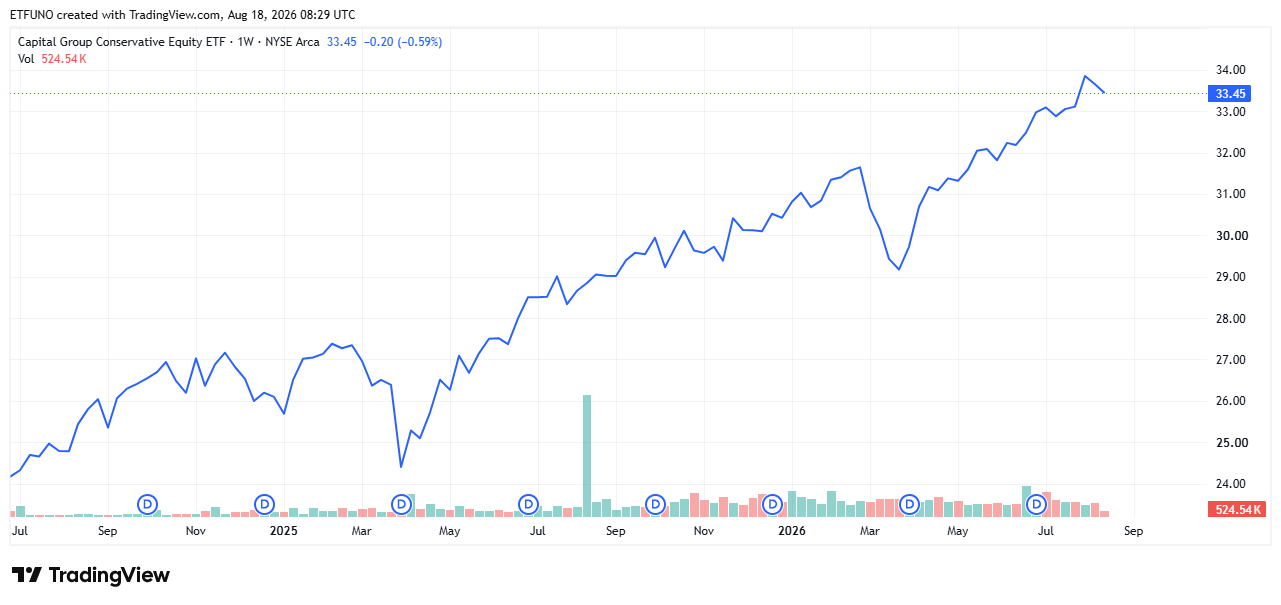
To judge an active manager, we have to look at objective data. CGCV was launched on June 25, 2024. As of late 2026, the fund has amassed roughly $2.03 billion in assets under management. Gathering over two billion dollars in just two years is a massive commercial success, indicating strong institutional and retail demand for Capital Group's ETF wrappers.
Let us look at the performance data. We will compare CGCV’s trailing 1-year returns against the S&P 500 and the average Large Value ETF category.
CGCV | S&P 500 Index | Large Value Category Average | |
|---|---|---|---|
1-Year Return | 15.83% | 19.56% | 18.75% |
Expense Ratio | 0.33% | 0.03%(VOO) | 0.44% |
Dividend Yield (TTM) | 1.44% | 1.30% | ~2.10% |
Holdings Count | 72 | 500 | Varies |
Over the past year, CGCV lagged the S&P 500. That is expected. The market was driven by an AI and mega-cap tech melt-up. A conservative fund is built to underperform in that kind of speculative rally. If it beat the index, managers would be taking unapproved risks.
The real test is against peers. In its first full calendar year (2025), CGCV beat its Large Value category average and finished in the top third. That shows the stock-picking process works against comparable active funds, even while trailing the broader market.
ETF Radar View
The radar chart below shows the general characteristics of the ETF:

CGCV on the Radar

For each domain, higher scores indicate better suitability for investment
Top 3 Reasons to Invest
Active Risk Mitigation: Passive index funds are entirely exposed to market sentiment. If panic sets in and the S&P 500 drops 20%, an S&P 500 ETF will drop exactly 20%. Active managers have the ability to play defence. Because CGCV is actively managed, the portfolio team can shift capital away from overvalued sectors and hide in defensive strongholds like healthcare and consumer staples before a recession hits. The mandate to preserve capital means the managers are constantly stress-testing their holdings against potential economic shocks. You are paying them to worry about downside risk so you do not have to.
The Multi-Manager Advantage: Most active funds rely on a "star manager" system. A single brilliant portfolio manager makes all the calls. When they are hot, the fund prints money. When they lose their edge, or when they retire, the fund collapses. Capital Group uses a proprietary multi-manager system. They divide the overall fund into distinct sleeves, and they hand each sleeve to an independent portfolio manager. These managers invest their slice of the pie according to their own highest convictions. This smooths out performance volatility. If one manager makes a terrible call on a specific financial stock, the other managers' successful picks in technology or industrials easily absorb the blow.
Realistic Dividend Sustainability: Chasing high yields usually ends in disaster. A company paying a double-digit dividend is often doing so because its stock price has collapsed, and a dividend cut is imminent. Capital Group understands this. CGCV does not chase the highest yielders in the market. They target companies with fortress-like balance sheets that can actually afford to pay and grow their dividends over the next decade. This focus on dividend sustainability over sheer yield protects investors from the sharp capital losses that always follow corporate dividend cuts.
Top 3 Reasons Not to Invest
The Short Track Record: We cannot ignore the calendar. CGCV launched in June 2024. While Capital Group has been managing money since the 1930s, this specific ETF wrapper has only existed for roughly two years. We have not seen how this exact fund behaves during a prolonged, multi-year bear market. The underlying stock-picking philosophy is proven, but the actual execution within this specific ETF structure lacks long-term historical data. Investors who demand a ten-year track record before committing capital will find CGCV too young to trust.
Performance Lag in Bull Markets: If you demand downside protection, you must accept upside limitation. CGCV is structurally designed to lag the S&P 500 during rampant bull markets. We saw this play out over the trailing twelve months. While the market surged over 22% on the back of tech enthusiasm, CGCV captured just under 16%. If you are a high-conviction investor who wants maximum exposure to economic expansion, the conservative mandate of this fund will act as a frustrating drag on your returns.
Mega-Cap Overlap Issues: A quick glance at CGCV’s top holdings reveals a familiar list: Microsoft, Broadcom, Eli Lilly, Apple, and Alphabet. These companies also dominate the S&P 500 and the Nasdaq 100. If you already hold large positions in broad market index funds, adding CGCV to your portfolio might not provide the diversification you think it does. You are essentially just buying Microsoft and Broadcom a second time, albeit at different portfolio weightings. You must check your portfolio overlap before buying this fund to ensure you are not accidentally concentrating your risk in a handful of mega-cap stocks.
🧱Building a True Portfolio Fortress
The Capital Group Conservative Equity ETF is exactly what it claims to be on the tin. It is a reasonably priced, actively managed defensive shield backed by a financial powerhouse. It will not double your money overnight, but it will help ensure you actually sleep at night when the market inevitably throws a tantrum.

CGCV: A Tool, Not a Treasure
Join the ETF UNO community today. We are building a club of smart, pragmatic investors who read the fine print, ignore the noise, and actually understand what they hold. Sign up for our weekly deep dives, and let us keep navigating these markets together.
P.S.: The Two-Engine Portfolio: a 25-page PDF on how I manage money across fiat cashflow and self-custodied Bitcoin — without letting either system dominate my life. $19 →

DISCLAIMER: This article is for informational purposes only and should not be considered as investment advice. Always conduct your own research and consult with a financial advisor before making investment decisions.
