

Hey ETF UNO community. Let’s talk about the giant sitting in the corner of the income-investing room.
If you spend any time looking at dividend yields, you have seen the hype around covered call funds. They promise massive yields, monthly payouts, and a smoother ride. At the absolute centre of this conversation is the JPMorgan Equity Premium Income ETF, known by its famous ticker: $JEPI ( ▼ 0.22% ).
With tens of billions in assets under management, JEPI has become a phenomenon. But Wall Street does not hand out free lunches. If a fund is throwing off a 7% or 8% yield in a world where standard savings accounts are just starting to pull back from their peaks, something has to give. You are making a trade-off.
Today, we are popping the hood on JEPI. We will look at exactly how it generates that cash, why it behaves the way it does, and whether it actually deserves a spot in your portfolio.
What is JEPI?
Most dividend ETFs just buy a basket of companies that pay out a portion of their profits. JEPI does not play that simple game. It combines active stock selection with a derivatives strategy to manufacture its high yield.
The fund has three distinct engines driving its performance.
1. The Defensive Equity Portfolio🛡️
JEPI does not just blindly track the S&P 500. The managers employ a bottom-up, fundamental research process to pick stocks. They rank companies based on proprietary risk-adjusted metrics.
What does that actually mean for you? It means they deliberately hunt for lower-volatility, defensive companies. They want stocks that do not swing wildly on earnings days. Think utilities, consumer staples, and mature healthcare businesses. This creates a base portfolio that is structurally less volatile than the broader market. When the S&P 500 drops 2%, JEPI’s underlying stock portfolio is designed to drop less.

The Defensive Equity Engine
2. The Options Overlay (The Cash Machine)💸
This is where the magic happens. To generate that massive monthly yield, JEPI writes (sells) out-of-the-money call options on the S&P 500 Index.
If you are new to options, think of selling a covered call like renting out your house while capping your upside on the sale price. Imagine you own a house worth $500,000. Someone comes along and says, "I will pay you $10,000 in cash right now, but if the house value rises above $550,000 this year, I get to keep any profit above that number."
You take the $10,000. You get paid immediately. If the house drops in value, stays flat, or rises to $549,000, you keep the house and the cash. You win. But if the market goes crazy and your house shoots up to $700,000, you miss out on that massive windfall.

💸The Covered Call Cash Machine
JEPI does this exact thing with the S&P 500. By selling "out-of-the-money" options, they leave a little bit of room for the fund to grow. But if the market goes on an absolute tear, JEPI caps its own upside. The fund sells that future potential to generate hard cash today.
3. Equity-Linked Notes (ELNs)
Here is a technical detail most people miss. JEPI does not actually sit at a trading desk selling individual S&P 500 options. The managers use instruments called Equity-Linked Notes (ELNs).
An ELN is a special contract created by a major bank. JPMorgan pays these banks to package the S&P 500 returns along with the income from selling call options into one neat product. JEPI invests up to 20% of its assets in these ELNs to generate the income, while the other 80% sits in their defensive stock picks. This structure is highly efficient, but it does introduce a tiny bit of counterparty risk—meaning you are trusting the banks issuing the ELNs to make good on their contracts.
You cannot discuss JEPI without talking about its newer, louder sibling: JEPQ (JPMorgan Nasdaq Equity Premium Income ETF).
Investors constantly ask which one they should buy. The mechanics of both funds are almost identical. They both pick stocks, and they both use ELNs to sell out-of-the-money call options. The difference lies entirely in the underlying index.
JEPI focuses on the S&P 500. It is defensive, value-oriented, and heavily weighted towards old-economy sectors. JEPQ targets the Nasdaq-100. It is aggressive, growth-oriented, and completely dominated by massive technology companies.
Options pricing relies heavily on a metric called implied volatility. Higher volatility means higher option premiums. Because tech stocks bounce around much more than utility companies, the options JEPQ sells are worth more money. Consequently, JEPQ generally offers a higher dividend yield than JEPI.
Feature | JEPI | JEPQ |
|---|---|---|
Underlying Focus | S&P 500 (Defensive/Value) | Nasdaq-100 (Growth/Tech) |
Volatility Profile | Lower (Less dramatic swings) | Higher (More dramatic swings) |
Historical Yield | Usually 7% - 9% | Usually 9% - 11% |
Capital Appreciation | Low | Moderate to High |
Target Investor | Income with downside cushion | Income with growth tilt |
Which one should you pick? 🤔Look at your own risk tolerance. If your primary goal is capital preservation and steady income, JEPI is your anchor. If you have a longer time horizon, can stomach tech-sector drawdowns, and want a higher yield with a bit more growth, JEPQ is the better tool for the job.

🎯What Are You Solving For?
Investment Strategy📊
Let’s talk practical application. If you hold a portfolio entirely made of ETFs, how do you actually use JEPI? It is a common mistake to look at the yield and decide to dump 50% of your net worth into it.
JEPI is not a total market replacement. It is a specific tool designed to solve a specific problem. Here are three ways to integrate it correctly.
🧘The Volatility Dampener: If you hold a standard 80/20 portfolio (80% stocks like VOO or QQQ, and 20% bonds like BND), you might find the stock portion too aggressive during bear markets. By carving out 10% to 15% of your equity allocation and replacing it with JEPI, you lower the overall beta (volatility) of your portfolio. You trade away a fraction of your long-term compound growth for a smoother emotional ride and a higher cash flow floor.
🌉The Income Bridge: For investors nearing retirement, transitioning from accumulating wealth to spending it is psychologically brutal. Selling shares of your favourite stock to buy groceries feels terrible. JEPI works brilliantly as an income bridge. If you need $2,000 a month to cover living expenses, you can allocate a specific portion of your portfolio to JEPI to generate that cash directly. You leave your core growth ETFs completely alone to continue compounding in the background.

A Brilliant Income Bridge
☂️The Tax-Sheltered Engine: You must understand the tax implications of JEPI. Because the fund uses options to generate its payout, the distributions are generally taxed as ordinary income, not qualified dividends. If you hold JEPI in a standard taxable brokerage account, the taxman will take a massive bite out of your monthly payouts. The optimal strategy is to place JEPI inside a tax-advantaged account (like an IRA in the U.S.). This allows the 7% to 9% yield to compound without tax drag, turning it into a powerful engine for buying more shares of either JEPI itself or other ETFs in your portfolio.
JEPI at a glance
ETF Issuer: JP Morgan Asset Management
Inception: 2020-05-20
Asset Class: Equity
Underlying Index: JEPI is an active ETF
Geographical Focus: U.S.
Expense Ratio: 0.35% (as of last data point)
Dividend Yield: 8.01% (as of last data point)
Distribution Frequency: Monthly
Want the full picture? See JEPI's full holdings, fees and sector breakdown.
Historical Performance
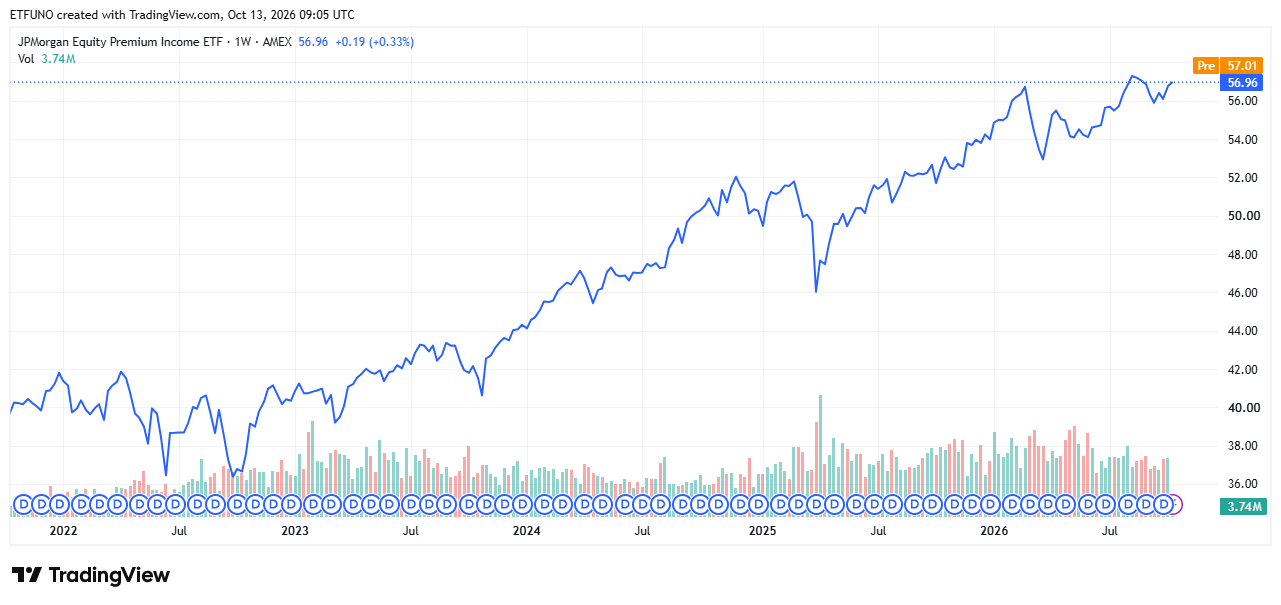
JEPI launched in May 2020. The timing provides us with a fascinating case study because we have seen it operate in completely different market environments.
The 2022 Bear Market (The Glory Year) When inflation spiked and central banks hiked interest rates aggressively, the S&P 500 fell nearly 20%. This is the exact environment JEPI was engineered for. Because the fund holds defensive stocks, the underlying portfolio did not crash as hard as the tech sector. More importantly, market fear was extremely high. High fear equals high volatility, which meant the call options JEPI sold were fetching massive premiums. The fund distributed huge monthly yields while protecting its principal far better than the broader market. JEPI looked like a miracle product.
The 2023-2024 Bull Run (The Reality Check) Then the market flipped. Artificial intelligence took over the narrative, and massive mega-cap tech stocks dragged the S&P 500 to record highs. Market volatility dropped to near historic lows.
This environment highlights JEPI's mechanical weaknesses. Because volatility was low, the options premiums dried up. The monthly yield dropped. Worse, because the market was rocketing upward, JEPI’s sold options capped its growth. The broader market completely left JEPI in the dust regarding total return.
This history is not a flaw in the fund; it is the fund doing exactly what it was programmed to do. It trades away the peaks of a bull market to cushion the valleys of a bear market.
ETF Radar View
The radar chart below shows the general characteristics of the ETF:

JEPI on the Radar

For each domain, higher scores indicate better suitability for investment
Top 3 Reasons to Invest
Exceptional and Consistent Cash Flow: The primary reason to own JEPI is the monthly paycheck. While traditional dividend ETFs pay out quarterly and yield roughly 2% to 3%, JEPI targets a massive 7% to 9% annualised distribution, paid every single month. This creates highly predictable cash flow for retirees or investors looking to fund living expenses without touching their principal capital.
Professional Active Management at a Low Cost: Active management is usually expensive. Hedge funds and mutual funds routinely charge upwards of 1.00% to manage complex options strategies. JPMorgan has packaged a sophisticated, institutional-grade active strategy into a liquid ETF wrapper for an expense ratio of just 0.35%. You are getting access to top-tier fundamental research and derivatives trading for a fraction of the traditional cost.
Capitalising on Market Fear: Volatility is the enemy of the standard stock investor. For JEPI, volatility is fuel. When markets panic, the price of options goes up. Because JEPI acts as the seller of these options, a fearful, choppy market directly translates to higher monthly distributions for the fund’s shareholders. It turns market anxiety into an asset.
Top 3 Reasons Not to Invest
Permanently Capped Upside: The covered call strategy sells upside beyond a strike price. In a year like 2026, when the S&P 500 rallies 13% and JEPI returns 6%, that cap costs you real money. Over a 20-year horizon, giving up even 2-3% annually compounds into a massive opportunity cost.
Not a Bond Replacement: If you're using JEPI as your fixed income allocation, you're taking equity risk without the contractual safety of bonds. The manager team warns against this framing. When the next real bear market arrives, JEPI will fall — just less than the S&P 500. That's not the same as stability.
Tax Inefficiency: Distributions are taxed as ordinary income. In a taxable account, that's a serious drag compared to qualified dividends from a traditional equity ETF. If you're in a high tax bracket, the after-tax yield looks far less attractive.
JEPI: How to Correctly Size it in Your Portfolio🏗️
Investing in JEPI requires you to be brutally honest about what you actually want from your money. If you are thirty years old with a long horizon, chasing a high yield at the expense of compounding growth is a mathematical mistake. You need the wild, uncapped upside of the broader market to build real wealth.
But if you are shifting into the preservation phase of life, the rules change entirely. When capital preservation, lower volatility, and predictable monthly cash flow become your primary goals, JEPI transforms into one of the most effective tools on the market. It is not a magical wealth creator; it is a highly engineered yield engine. Treat it as a specific tool for a specific job, and it will serve your portfolio incredibly well.

🔧The Purpose-Built Income Tool
If you want to cut through the noise and get real, actionable insights on how to build a portfolio that actually works for your life, come join us over at the ETF UNO community. We analyse the funds, debate the strategies, and build better portfolios together. See you inside.
DISCLAIMER: This article is for informational purposes only and should not be considered as investment advice. Always conduct your own research and consult with a financial advisor before making investment decisions.
